The history of Cole Farm as featured on “The streets of the city” Radio Program (WEAN)
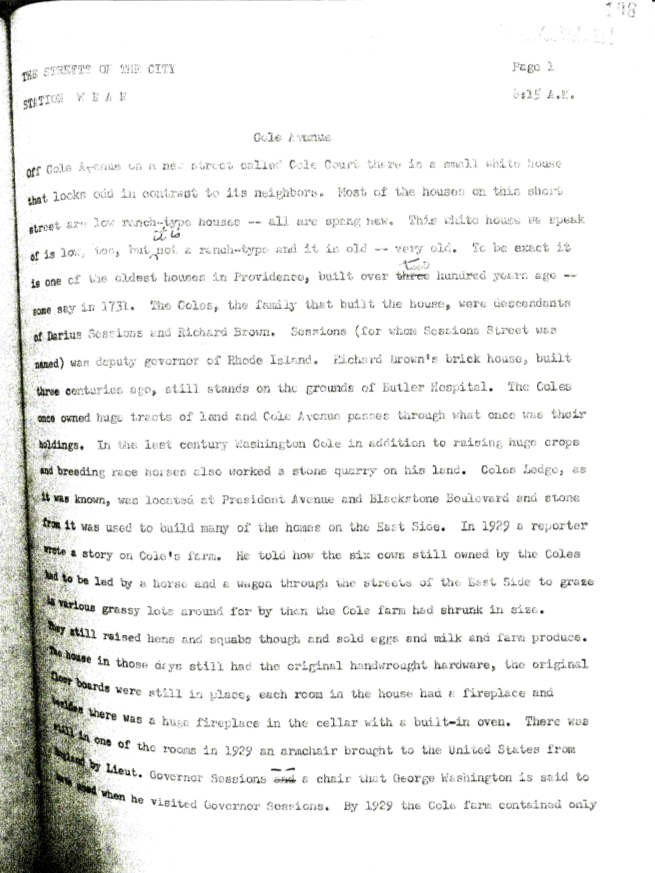
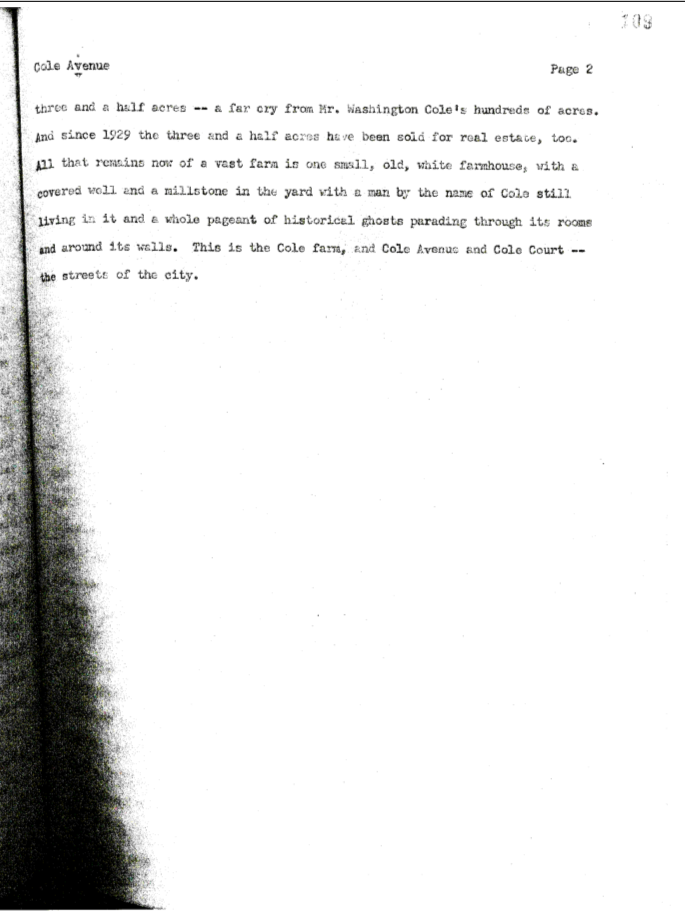
STREETS OF THE CITY (by Florence Parker Simister, transcripts of radio programs broadcast on WEAN 1954-1955)
STATION WEAN
Cole Avenue
Off Cole Avenue on a near street called Cole Court there is a small white house that looks odd in contrast to its neighbors. Most of the houses on this short street are low ranch-type houses — all are spang new. This white house we speak of is low, too, but it is not a ranch-type and it is old – very old. To be exact it is one of the oldest houses in Providence, built over two hundred years ago – some say in 1731. The Coles, the family that built the house, were descendants of Darius Sessions and Richard Brown. Sessions (for whom Sessions Street was named) was deputy governor of Rhode Island. Richard Brown’s brick house, built three centuries ago, still stands on the grounds of Butler Hospital. The Coles once owned huge tracts of land and Cole Avenue passes through what once was their holdings. In the last century Washington Cole in addition to raising huge crops and breeding racehorses also worked a stone quarry on his land. Coles Ledge, as it was known, was located at President Avenue and Blackstone Boulevard and stone from it was used to build many of the homes on the East Side. In 1929 a reporter wrote a story on Cole’s farm. He told how the six cows still owned by the Coles had to be led by a horse and a wagon through the streets of the East Side to graze is various grassy lots around for by then the Cole farm had shrunk in size. They still raised hens and squabs though and sold eggs and milk and farm produce. The house in those days still had the original handwrought hardware, the original floor boards were still in place, each room in the house had a fireplace and besides there was a huge fireplace in the cellar with a built-in oven. There was still in one of the rooms in 1929 an armchair brought to the United States from byland by Lieut. Governor Sessions — a chair that George Washington is said to have used when he visited Governor Sessions. By 1929 the Cole farm contained only three and a half acres — a far cry from Mr. Washington Cole’s hundreds of acres. And since 1929 the three and a half acres have been sold for real estate, too. All that remains now of a vast farm is one small, old, white farmhouse, with a covered well and a millstone in the yard with a man by the name of Cole still living in it and a whole pageant of historical ghosts parading through its rooms and around its walls. This is the Cole farm, and Cole Avenue and Cole Court –- the streets of the city.
 The historic Cole Farmhouse