THE PROVIDENCE SUNDAY JOURNAL MAGAZINE, NOVEMBER 24, 1929
Cole Farm, in Centre of Residential Section, Takes Cattle to Pasture Past Exclusive Homes – House Built in 1731
WITHIN a stone’s throw of Blackstone boulevard and some of the finest residences, and best residential property, in the city, Cole’s Farm, an odd relic of the past, with its colonial house built in 1731, is approaching its end – perhaps. For there are many who have been predicting its conversion into house-lots for years.
But Francis L. Cole, descendant of Darius Sessions, deputy governor of the colony before the Revolution; and of Richard Brown, who built the house now standing on the farm before Rhode Island became independent, has no desire to sell. He is still carrying on, farming his three and a half acres, producing and selling milk, chickens and squabs, and still cutting wood from his “wood-lot.”
Rivalled Only by Dexter
While there are several farms within the city’s borders, Cole’s Farm is unique because of its situation in what has become in recent years a high-class residential section. It probably never will complete with the city’s famous Dexter Asylum farm, entrenched behind its thick stone walls in a still more valuable and entirely built-up section. Dexter, with its legal entanglements which prevent the city from selling, will undoubtedly survive long after Cole Farm has become a memory. But today this unusual place is Dexter’s closest rival.
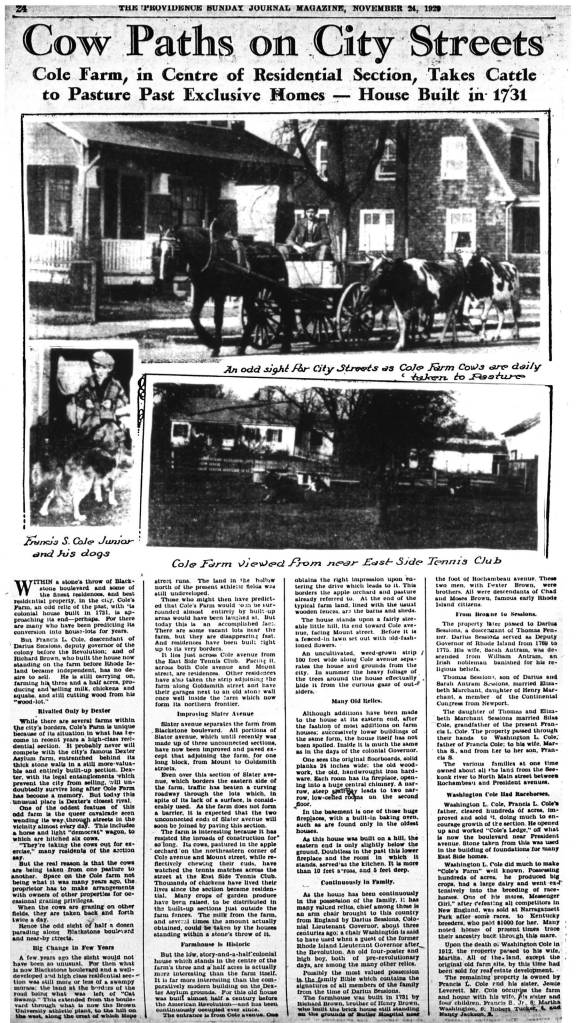
One of the oddest features of this odd farm is the queer cavalcade seen wending its way through streets in the vicinity almost every day. This includes a horse and light “democrat” wagon, to which are hitched six cows.
“They’re taking the cows out for exercise,” many residents of the section say.
But the real reason is that the cows are being taken from one pasture to another. Space on the Cole farm not being what it was many years ago, the proprietor has to make arrangements with owners of other properties for occasional grazing privileges.
When the cows are grazing on other fields, they are taken back and forth twice a day.
Hence the odd sight of half a dozen parading along Blackstone boulevard and near-by streets.
Big Change in Few Years
A few years ago the sight would not have been so unusual. For then what is now Blackstone boulevard and a well-developed and high class residential section was still more or less of a swampy morass; the land at the borders of the road being what was left of “Cat Swamp.” This extended from the boulevard through what is now the Brown University athletic plant, to the hill on the west, along the crest of which Hope street runs. The Land in the hollow north of the present athletic fields was still undeveloped.
Those who might then have predicted that Cole’s Farm would soon be surrounded almost entirely by built-up areas would have been laughed at. But today this is an accomplished fact. There are some vacant lots near the farm, but they are disappearing fast. And residences have been built sight up to its very borders.
It lies just across Cole avenue from the East Side Tennis Club. Facing it, across both Cole avenue and Mount street, are residences. Other residences have also taken the strip adjoining the farm along Goldsmith street and have their garages next to an old stone wall once well inside the farm which now form its northern frontier.
Improving Slater Avenue
Slater avenue separates the farm from Blackstone boulevard. All portions of Slater avenue, which until recently was made up of three unconnected sections, have now been improved and paved except that adjoining the farm, for one long block, from Mount to Goldsmith streets.
Even over this section of Slater avenue, which borders the eastern side of the farm, traffic has beaten a curving roadway through the lots which, in spite of its lack of a surface, is considerably used. As the farm does not form a barrier, it is expected that the two unconnected ends of Slater avenue will soon be joined by paving this section.
The farm is interesting because it has resisted the inroads of construction for so long. Its cows, pastured in the apple orchard on the northeastern corner of Cole avenue and Mount street, while reflectively chewing their cuds, have watched the tennis matches across the street at the East Side Tennis Club. Thousands of chickens have lived their lives since the section became residential. Many crops of garden produce have been raised, to be distributed in the built-up sections just outside in the farm fences. The milk from the farm, and several times the amount actually obtained, could be taken by the houses standing within a stone’s throw of it.
Farmhouse is Historic
But the low, story-and-a-half colonial house which stands in the centre of the farm’s three and a half acres is actually more interesting than the farm itself. It is far more interesting than the comparatively modern building on the Dexter Asylum grounds. For this old house was built almost half a century before the American Revolution – and has been continuously occupied ever since.
The entrance is from Cole avenue. One obtains the right impression upon entering the drive which leads to it. This borders the apple orchard and pasture already referred to. At the end of the typical farm land, lined with the usual wooden fences, are the barns and sheds.
The house stands upon a fairly sizeable little hill, its end toward Cole avenue, facing Mount street. Before it is a fenced-in lawn set out with old-fashioned flowers.
An uncultivated, weed-grown strip 100 feet wide along Cole avenue separates the house and grounds from the city. In summer the heavy foliage of the trees around the house effectually hide it from the curious gaze of outsiders.
Many Old Relics.
Although additions have been made to the house at its eastern end, after the fashion of most additions on farm houses; successively lower buildings of the same form, the house itself has not been spoiled. Inside it is much the same as in the days of the colonial Governor.
One sees the original floorboards, solid planks 24 inches wide; the old woodwork, the old, handwrought iron hardware. Each room has its fireplace, opening into a huge central chimney. A narrow, steep stairway leads to two narrow, low-celled rooms on the second floor.
In the basement is one of those huge fireplaces, with a built-in baking oven, such as are found only in the oldest houses.
As this house was built on a hill, the eastern end is only slightly below the ground. Doubtless in the past this lower fireplace and the room in which it stands, served as the kitchen. It is more than 10 feet across, and 5 feet deep.
Continuously in Family.
As the house has been continuously in the possession of the family. It has many valued relics, chief among these is an arm chair brought to this country from England by Darius Sessions. Colonial Lieutenant Governor, about three centuries ago; a chair Washington is said to have used when a guest of the former Rhode Island Lieutenant Governor after the Revolution. An old four-poster and high boy, both of pre-revolutionary days, are among the many other relics.
Possibly the most valued possession is the family Bible which contains the signatures of all members of the family from the time of Darius Sessions.
The farmhouse was built in 1731 by Richard Brown, brother of Henry Brown, who built the brick house still standing on the grounds of Butler Hospital near the foot of Rochambeau avenue. These two men, with Dexter Brown, were brothers. All were descendants of Chad and Moses Brown, famous early Rhode Island citizens.
From Browne to Sessions.
The property later passed to Darius Sessions, a descendant of Thomas Fenner. Darius Sessions served as Deputy Governor of Rhode Island from 1769 to 1775. His wife, Sarah Antram, was descended from William Antram, an Irish nobleman banished for his religious beliefs.
Thomas Sessions, son of Darius and Sarah Antram Sessions, married Elizabeth Marchant, daughter of Henry Marchant, a member of the Continental Congress from Newport.
The daughter of Thomas and Elizabeth Marchant Sessions married Silas Cole, grandfather of the present Francis L. Cole. The property passed through their hands to Washington L. Cole, father of Francis Cole; to his wife, Martha S., and from her to her son, Francis S.
The various families at one time owned about all the land from the Seekonk river to North Main street between Rochambeau and President avenues.
Washington Cole Had Racehorses.
Washington L. Cole, Francis L. Cole’s father, cleared hundreds of acres, improved and sold it, doing much to encourage growth of the section. He opened up and worked “Cole’s Ledge,” off what is now the boulevard near President avenue. Stone taken from this was used in the building of foundations for many East Side homes.
Washington L. Cole did much to make “Cole’s Farm” well known. Possessing hundreds of acres, he produced big crops, had a large dairy and went extensively into the breeding of racehorses. One of his mares, Messenger Girl,” after defeating all competitors in New England, was sold at Narragansett Park after some races, to Kentucky breeders, who paid $1000 for her. Many noted horses of present times trace their ancestry back through this mare.
Upon the death of Washington Cole in 1912, the property passed to his wife, Martha. All of the land, except the original old farm site, by this time had been sold for real estate development.
The remaining property is owned by Francis L. Cole and his sister, Jessie Leverett, Mr. Cole occupies the farm and house with his wife, his sister and four children. Francis S., Jr., 8; Martha Washington, 6; Robert Tucker, 4, and Nancy Jackson, 2.
 The historic Cole Farmhouse
One thought on “Cow Paths on City Streets”