Upper East Side, Newest Neighborhood in Providence, Was Farm Land and Negro Village Before 1890
THE EVENING BULLETIN, PROVIDENCE, THURSDAY, JANUARY 19, 1928
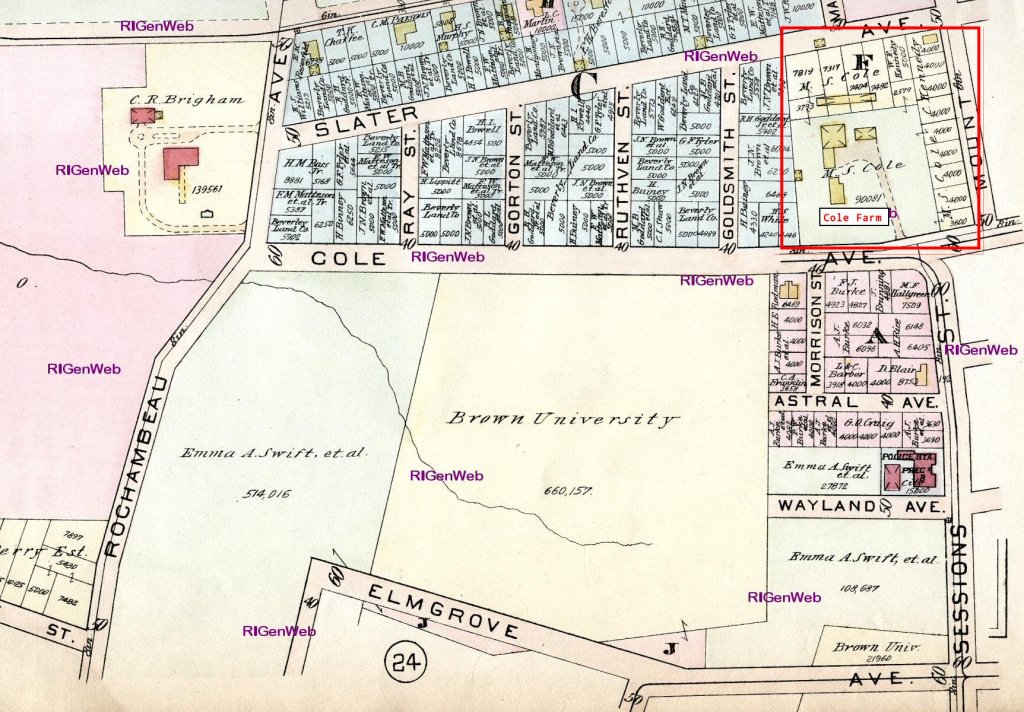
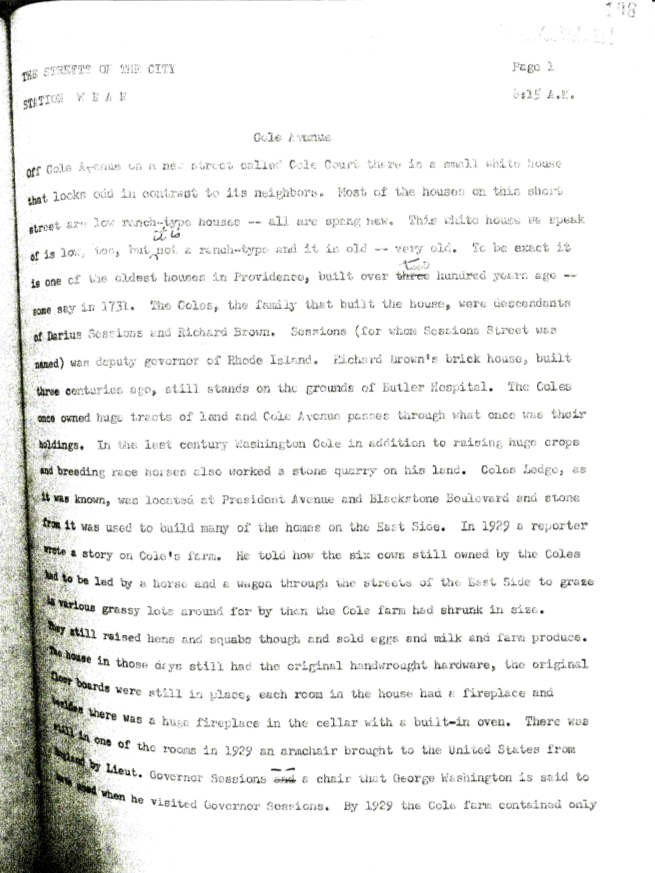
Probably the oldest settlement in this section of the city is “Cole’s Village.” at the foot of Sessions Street. Records in the possession of Frank Cole, prominent dairyman and former member of the State Board of Agriculture, show that the Cole house, in which he makes his home with his family and his sister, Jessie, was erected by Richard Brown in 1732.
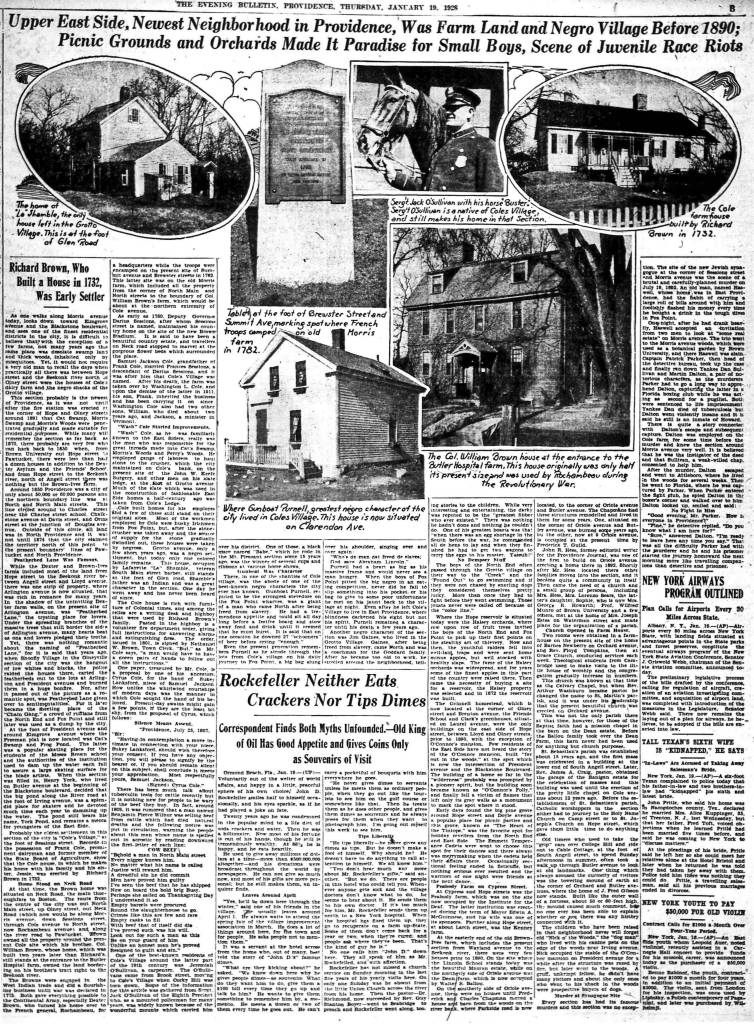
Richard Brown, Who Built a House in 1732, Was Early Settler.
As one walks along Morris Avenue today, looks down toward Elmgrove Avenue and the Blackstone boulevard. and sees one of the finest residential districts in the city. It is difficult to believe that with the exception of a few farms, not many years ago this same place was desolate swamp lan1 and thick woods, inhabited only by mosquitoes. Yet, it would not require a very old man to recall the days when practically all there was between Hope Street and the Seekonk River north of Olney Street were the houses of Cole’s dairy farm and the negro shacks of the Grotto village.
This section probably is the newest of Providence, as it was not until after the fire station We erected at the corner of Hope and Olney streets around 1891 that Cat Swamp. Morris Swamp and Morris’s Woods were penetrated gradually and made suitable for residential purposes. While many will remember the section as far back as 1870, there probably are very few who can hark back to 1850 when, from Brown University out Hope Street Pawtucket, there were less than half a dozen houses in addition to the Dexter Asylum and the Friends School and from Hope Street to the Seekonk River, north of Angell Street there was nothing but the Brown-Ives farm.
Around 1850 Providence was a city of only about 50,000 or 60.000 persons and the northern boundary line was at North and North Main streets. This line circled around to Charles Street near the Charles Street school. Chalkstone avenue at Davis Street, and Orin’s street at the junction of Douglas Avenue. Outside of this circle. all land Was in North Providence, and it was not until 1874 that the city claimed the territory north of this point to the present boundary lines of Pawtucket and North Providence.
Featherbed ‘Lane Was Famous. While the Dexter and Brown-Ives farms included most of the land from Hope Street to the Seekonk River between Angell Street and Lloyd Avenue. there was one strip of property, where Arlington Avenue is now stunted, that WAS rich in romance for many years. In the shadow of the uninviting Dexter farm walls, on the present site of Arlington Avenue, was “Featherbed Lane,” the trysting place for lovers, Under the spreading branches of the massive trees that still border the sides of Arlington Avenue, many hearts beat as one and lovers pledged their troths.
Yet, there was nothing romantic about the naming of “Featherbed Lane, for it is said that years ago. when Shoofly Village in the Olney Ville section of the city was the hangout of low whites and blacks, the police raided the houses there, carted the featherbeds out to the lots at Arlington and President avenues and burned them in & huge bonfire. Nor, after it passed out of the picture as a romantic spot, was Featherbed Lane given over to sentimentalities. For it later became the meeting place of the “Chain Gang.” a crowd of ruffians from the North End and Fox Point and still I later was used as a dump by the city.
At the foot of President Avenue and around Elmgrove avenue where the Freeman plat is now located was Cat’s Swamp and Frog Pond. The latter was popular skating place for the students at the Moses Brown school and the authorities of the institution used to dam up the water each full to ensure a large skating surface for the blade artists. When this section Was filled in, Henry York, who lived on Butler Avenue at the beginning of the Blackstone boulevard, decided that the big pond along the river road at the foot of Irving Avenue, was splendid place for skaters and he devoted much time each year to damming up the water. The pond still bears his name, York Pond, and remains a mecca for youngsters of the East Side.
Probably the oldest settlement in this section of the city is “Cole’s Village.” at the foot of Sessions Street. Records in the possession of Frank Cole, prominent dairyman and former member of the State Board of Agriculture, show that the Cole house, in which he makes his home with his family and his sister, Jessie, was erected by Richard Brown in 1732.
Home Stood on Neck Road At that time, the Brown home was situated on Neck Road, the main thoroughfare to Boston. The route from the Centre of the city was out North Main Street, up Olney Street, out Neck Road (which now would be along Morris Avenue, down Sessions Street through Cole Avenue to North Street, now Rochambeau Avenue) and along the river road to Pawtucket. Brown owned all the property around the present Cole site which his brother. Col. William Brown, whose home, which was built two years later than Richard’s still stands at the entrance to the Butler Hospital farm, owned the land bordering on his brother’s tract right to the Seekonk River.
The Browns were engaged in the West Indian trade and aid a flourishing business until war was declared in 1775. Both gave everything possible to the Continental Army, especially Dexter Brown, who turned his home over to the French general, Rochambeau, for a headquarters while the troops were encamped on be present site of Summit avenue and Brewster streets in 1782 This latter site was on the old Morris farm, which included all the property from the corner of North Main and North streets to the boundary of Col. William Brown’s farm, which would be about at the northern extremity of Cole Avenue.
As early as 1760. Deputy Governor Darius Session, after whom Sessions Street is named, maintained his country home on the site of the new Brown Stadium. It is said to have been a beautiful country estate, and travellers on Neck Road stopped to marvel at the gorgeous flower beds which surrounded the place.
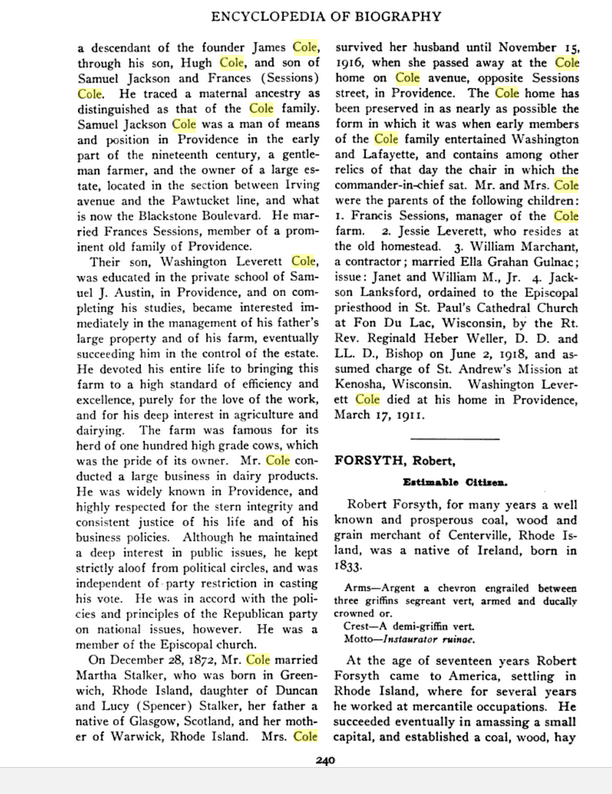
Samuel Jackson Cole, grandfather of Frank Cole, married Frances Sessions, a descendant of Darius Sessions, and it was after him that Cole’s Village was named. Alter his death, the farm WAS taken over by Washington L. Cole. And upon the demise of the latter in 1911 his son, Frank, inherited the business and has been carrying it on since Washington Cole also had two other sons, William, who died about two years ago, and Jackson, A minister in Vermont.
“Wash” Cole Started Improvements. “Wash” Cole, as he was familiarly known to the East Siders, really was the man who was responsible for the great inroads made into Cat’s Swamp. Morris’s Woods and Perry’s Woods. He employed gangs of laborers to haul stone to the crusher, which the city maintained on Cole’s bank, on the present site of the John W. Keefe Surgery, and other men on his slate ledge, at the foot of Grotto Avenue Much o! the slate which was used in the construction of fashionable East Side homes a half-century ago was taken from Cole’s Ledge.
Cole built homes for his employee And a few of these still stand on their original sites. Most of the workmen employed by Cole were husky Irishmen from Fox Point, but, after the stone crusher was taken away and the source of supply for the stone gradually dwindled out, these houses were taken by negroes. Grotto avenue, Only A few short year ago, Was A negro settlement, but today only one colored family remains. This house, occupied by Lafayette “La” Shamble, veteran South Main Street barber, still stands at the foot of Glen Road. Shamble’s father was an Indian and was a great character in the section. One day he went away and has never been heard of since.
The Cole house is rich with furniture of colonial times, and among the relics are a writing desk and highboy that were used by Richard Brown’s family….Is A volunteer fire department order, giving full instructions for answering alarms and extinguishing fires. The order issued in 1801, is signed by Nathaniel W. Brown, Town Clerk. “But.” As Mr. Cole says, “a man would have to have a dozen pairs of hands to follow out all the instructions.”One paper, treasured by Mr. Cole, is a proposal by one of his ancestors. Cyrus Cole, for the hand of Sukey Lankford niece of Samuel Jackson. How unlike the whirlwind courtship of modern days was the manner in which Cole sought the hand of his beloved. Present-day swains might gain a few points, if they are the least bit shy from the proposal of Cyrus, which follows:
Providence, July 25, 1807.
Silence Means Assent.
“Sir:
“Haring. In contemplation & more intimate in connection with your niece. Sukey Lankford, should wish therefore your consent. If you have any objection. you will please signify by the bearer or, if you should remain silent on this subject. shall conclude it meets your approbation. Most respectfully yours, Samuel Jackson.(Signed) Cyrus Cole.”
THE EVENING BULLETIN, PROVIDENCE, THURSDAY, JANUARY 19, 1928
There has been much talk about tuberculin tests for cattle recently, but it is nothing new for people to be wary of the beef they buy. In fact, around 1809. It was rumored that a man named Benjamin Pierce Wilbur Was selling beef from cattle which had died natural deaths and the following notice WAS put in circulation, warning the people about this man whose name is spelled out in Acrostic by reading downward the first letter of each line:
COW BEEF
“Behold a man in North Main Street
Every nigger knows him.
No matter what his name is called
Justice will reward him.
A dreadful sin he did commit
Men have proved him guilty
I‘ve seen the beef that he has shipped.
Now on board the bold brig Busy.
Perhaps she sailed on Thanksgiving Day
I understand it so
Empty barrels were procured
Round the slaughterhouse to go.
Crimes like this are few and rare
Empty casks to fill
with beef that of itself did die
I‘ve proved such was his will.
Look out for such a man as this
Be on your guard of him
Unlike an honest man he’s proved
Resigned to guilt and sin.”
One of the best-known residents of Cole’s village around the latter part of the 19th century was Jeremiah O’Sullivan, a carpenter. The O’Sullivan came from Brook Street, moving to Cole’s Village when Corky Hill was torn down. Some of the information for this article was gathered from Sergt. Jack O’Sullivan of the Eighth Precinct who as a mounted policeman for many years, was widely known because of the wonderful mounts which carried him over his district. One of these, a black mare named “Babe,” which he rode in the Mt. Pleasant section some 15 year ago, was the winner of several cups and ribbons at various horse shows.
Gunboat Was character
There, in one of the shanties of Cole village, was the abode of one of the best-known negro characters the city ever has known. Gunboat Purnell, reputed to be the strongest stevedore on the Fox Point wharves, was a giant of a man who came North after being freed from slavery. He had a tremendous appetite and would sit all day long before a festive board and stow Away food and drink until it seemed that he must burst. It is said that on one occasion he downed 27 “schooners” of beer before crying “enough.” Even the present generation remembers Purnell as he strode through the lots from Cole’s village on his daily Journey to Fox Point, a big bag slung over his shoulder, singing over and over again: “Who’s de man at freed de slaves. God save Abraham Lincoln.”
Purnell had heart as big as his massive frame and would never see a man hungry. When the boys of Fox Point pitted the big negro in an eating competition, never did he fall to slip something into his pocket, or his bag to give to some poor unfortunate he met on his Jaunt back to the village at night. Even after he left Cole’s Village to live in East Providence, where blindness darkened his right but not his spirit. Purnell remained character until his death a few years ago. Another negro character of the section was Jim Gaines, who lived in the Grotto Village. Gaines, after being freed from slavery came North and was A coachman for the Goddard family. After he became too old to work, he strolled around the neighbourhood, telling stories to the children. While very interesting and entertaining, the darky was reputed to be the greatest fibber who ever existed.” There was nothing he hadn’t done and nothing he couldn’t do. One of his greatest boasts was that when there was an egg shortage in the South before the war, he commanded all de hens to lay and when they finished, he had to get two wagons to carry the eggs to his master. Yassuh!”
No Dempsey Stuff
THE EVENING BULLETIN, PROVIDENCE, THURSDAY, JANUARY 19, 1928
The boys of the North End often passed through the Grotto village on their way to the “Creek” and the Found Out” to go swimming and if they were not chased by snarling dogs, they considered themselves pretty lucky. More than once they had to fight before they went swimming. Those jousts never were called off because of the “color line.”
Where the Hope reservoir is situated today were the Halsey orchards, where row upon row of fruit trees invited the boys of the North End and Fox Point to pick up their first points on the stealthy art of thievery. Now and then, the youthful raiders fell into well-laid traps and were sent home minus Apples, but well stocked with healthy slaps. The fame of the Halsey orchards was widespread, and for years some of the finest apples in this part of the country were raised there. Then come the necessity of buying site for a reservoir, the Halsey property was selected and in 1872 the reservoir WAS built.
The Grinnell homestead, which is now located at the corner of Olney Street and Brenton Avenue, the Friends School, and Clark’s greenhouses, situated on Laurel Avenue, were the only buildings on the east side of Hope Street, between Lloyd and Olney streets, prior to 1890, with the exception of O’Connor’s mansion. Few residents of the East Side hare not heard the story of the O’Connor mansion built “far out in the woods.” At the spot which is now the intersection of President Avenue and the Blackstone Boulevard. The building of a home so far in the “wilderness” probably was prompted by A pioneer spirit, but the building soon became known as “O’Connor’s Folly.” and finally fell a victim of flames that left only its gray walls as a monument to mark the spot where it stood.
Early days found the big pine grove around Hope Street and Doyle Avenue a popular place for picnic parties and this grove, known as “The Heart of the Tin tops.” was the favourite spot for holiday revellers from the North End and East Side. The Emmett Temperance Cadets were wont to choose this spot for their dances and there always was merrymaking when the cadets held their affairs there. Occasionally sectional feeling ended in fisticuffs, but nothing serious ever resulted and the warriors of one night were friends at the next dance.
Peabody Farm on Cypress Street. At Cypress and Hope streets was the Peabody farm. which was on the site now occupied by the Institute for the Deaf. The latter institution was erected during the term of Mayor Edwin A. McGuinness and his wife was one of its sponsors. Farther along Hope Street, at about Larch Street, was the Kenney farm.
At the easterly end of the old Brown-lves farm, which includes the present section from Wayland Avenue to the Seekonk River, there were very few houses prior to 1890. On the site where the Lincoln School stands today was the beautiful Mauran estate, while on the northerly side of Oriole Avenue was the Dean farm, which is now occupied by Walter S. Ballou. On the southerly side of Oriole Avenue, there were no houses until Frederick and Charles Chapman moved a house and barn from the woods on the riverbank, where Parkside Road is now located to the corner of Oriole Avenue and Butler Avenue. The Chapmans had these structures remodelled and lived in them for some years, One, situated on the corner of Oriole Avenue and Butler Avenue, was burned some years ago, but the other, now at 9 Oriole Avenue, is occupied at the present time by Frederick T. Guild.
John R. Hess, former editorial writer for the providence Journal was one of the first to build on Oriole Avenue erecting a home there in 1892. Shortly after Mr. Hess located there other families moves into the section and it became quite & community in itself. Then came the need of a church and A small group of persons, including Mrs. Hess, Mrs. Lorenzo Sears, the latter’s daughter, Sophie, who is now Mrs. George R. Howarth; Prof. Wilfred Munro of Brown University and a few others, met at the home of Mrs. Joseph Estes on Waterman Street and made plans for the organization of a parish.
Church Opened in Farm House.
Two rooms were obtained in a farmhouse on the present site of the home of Barnes Newberry on Orchard Avenue, and Rev. Floyd Tompkins, then its Grace Church, conducted services each week. Theological students from Cambridge used to make visits to the little house of worship and the congregation gradually increase in numbers. This church was known at that time As the Calvary Chapel, but when Rev. Arthur Washburn became pastor he changed the name to St. Martin’s parish, and it was under his leadership that the present beautiful church WAS erected on Orchard Avenue.
This was not the only parish there at that time, however, for those of the Baptist faith had a mission chapel in the barn on the Dean estate. Before the Ballou family took over the Dean Farm, this barn never had been used for anything but church purposes. St. Sebastian’s parish was established About 15 years ago, and the first man was celebrated in a building at the lower end of South Angell Street. Later. Rev. James A. Craig, pastor, obtained the garage of the Banigan estate for the celebration of masses and this building was used until the erection of the pretty little chapel on Cole Avenue about 12 years ago. Before the establishment of St. Sebastian’s parish, Catholic worshippers in the section either had to journey to the Holy Name Church on Camp Street or to St. Joseph’s Church on Hope Street, which gave them little time to do anything else.
Old timers who used to take the “grip” cars over College Hill and ride out to Cable Cottage, at the foot of South Angell Street, to spend Sunday afternoons in summer, often took A walk up through Butler Avenue to look at old landmarks. One thing which always aroused the curiosity of visitors was the lowering mound of earth at the corner of Orchard and Butler avenues, where the home of J. Fred Gibson now stands. Built like the outer wall of a fortress, about 50 or 60-feet high, the mound caused much comment, be no one ever has been able to explain whether or not there was any history connected with it.
The children who have been raised in that neighbourhood never will forget old Nick o’ the Woods,” the “dog man” who lived with his canine pets on the edge of the woods near Irving Avenue. Nick occupied the stable of the O’Connor mansion on President Avenue for a while after the structure was razed by fire, but later went to the woods. A gruff unkempt fellow, he didn’t have many visitors and about the only ones who went to his shack in the woods were prospective buyers of dogs.



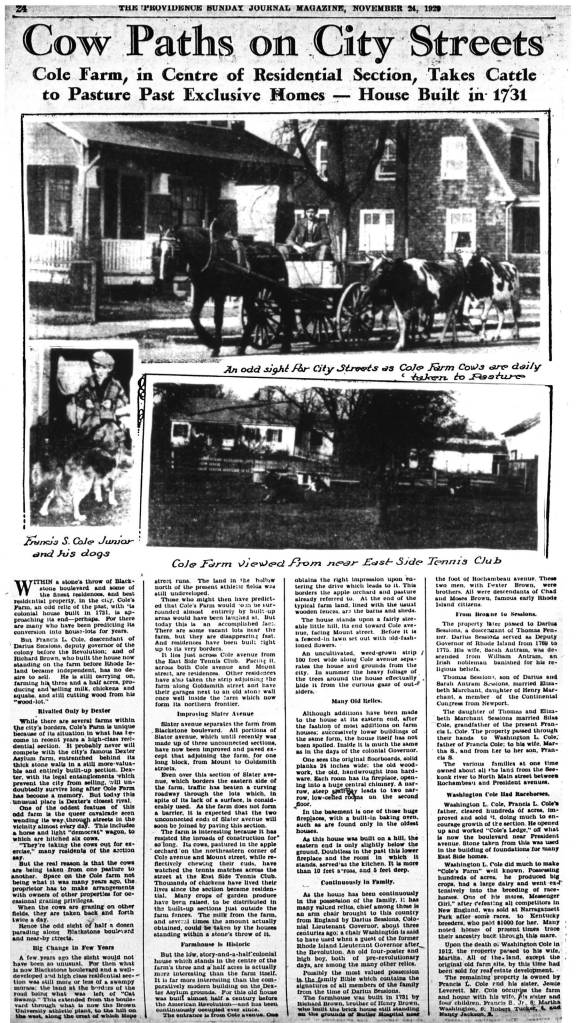
 The historic Cole Farmhouse
You must be logged in to post a comment.