Memorial Day 2022 🇺🇲🗽
May 30, 2022
#USA1731 honoring the nation’s heroes on Memorial Day.

#USA1731 honoring the nation’s heroes on Memorial Day.
Do you know? President George Washington was born on February 22, 1732. Cole Farmhouse was born a year earlier *1731* in Providence RI. Book your vacation now at http://www.USA1731.com
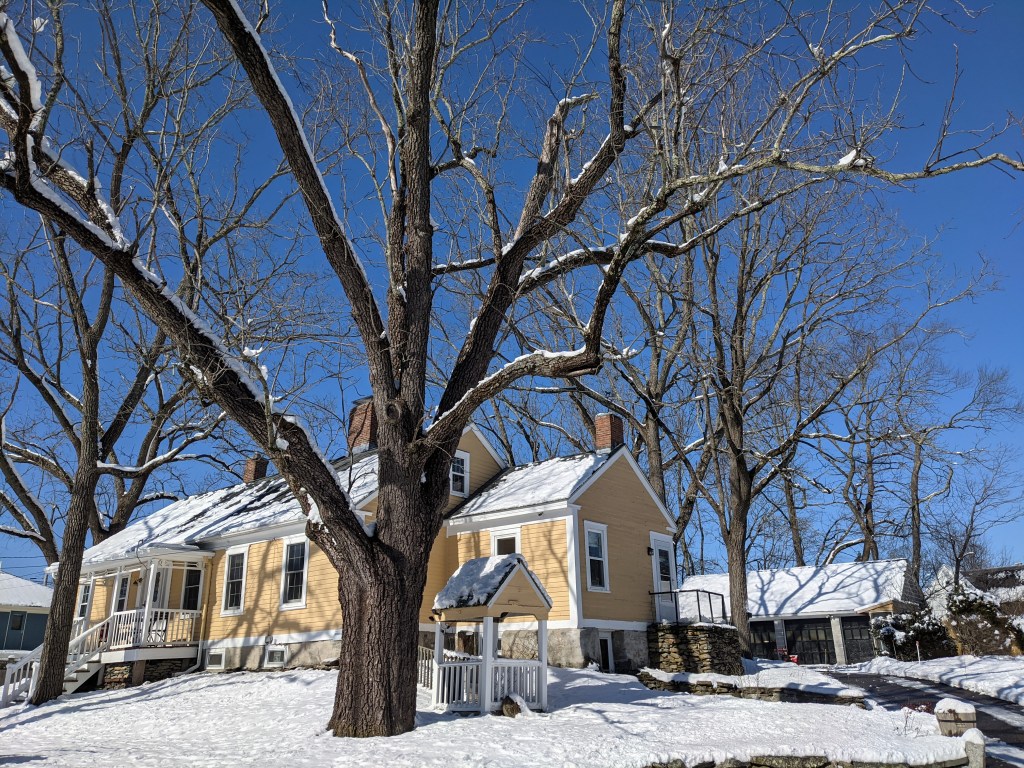
Fun fact: The Cole Farmhouse Vacation Rental was build in 1731, 45 years before the United States gained independence from Great Britain. Book your next vacation at: www.USA1731.com
Happy 4th!!
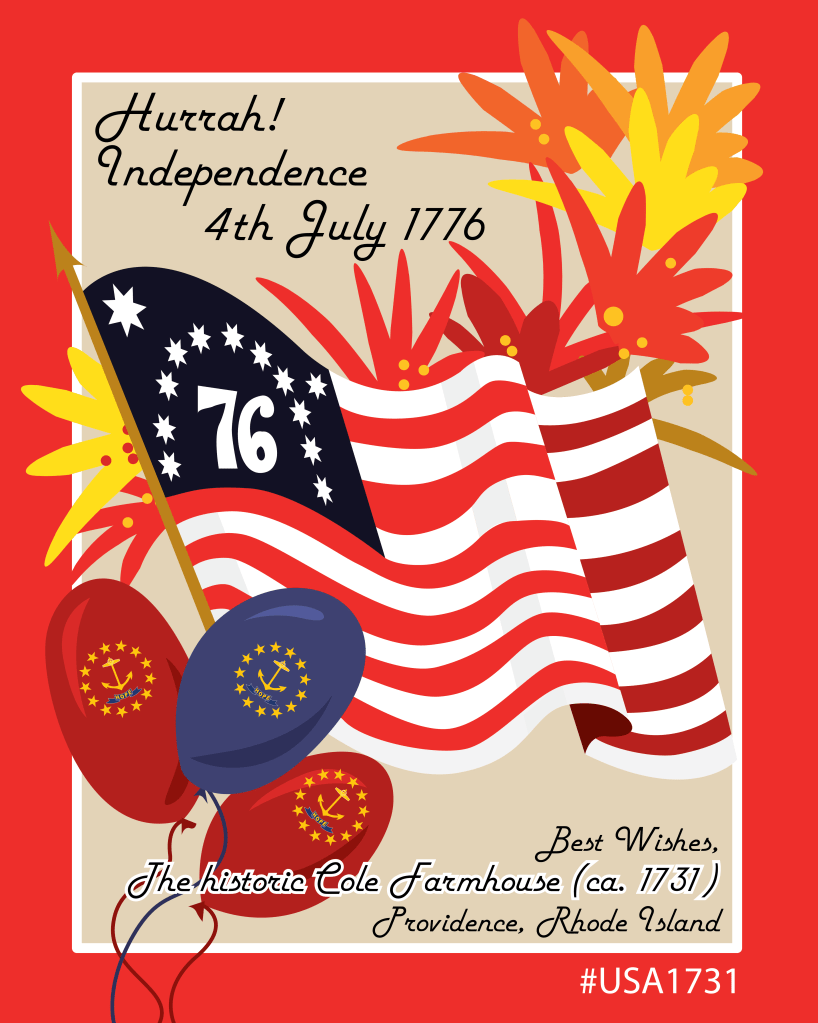
Fun fact: The Cole Farmhouse Vacation Rental was build in 1731, 45 years before the United States gained independence from Great Britain. Book your next vacation at: www.USA1731.com
Happy 4th!!
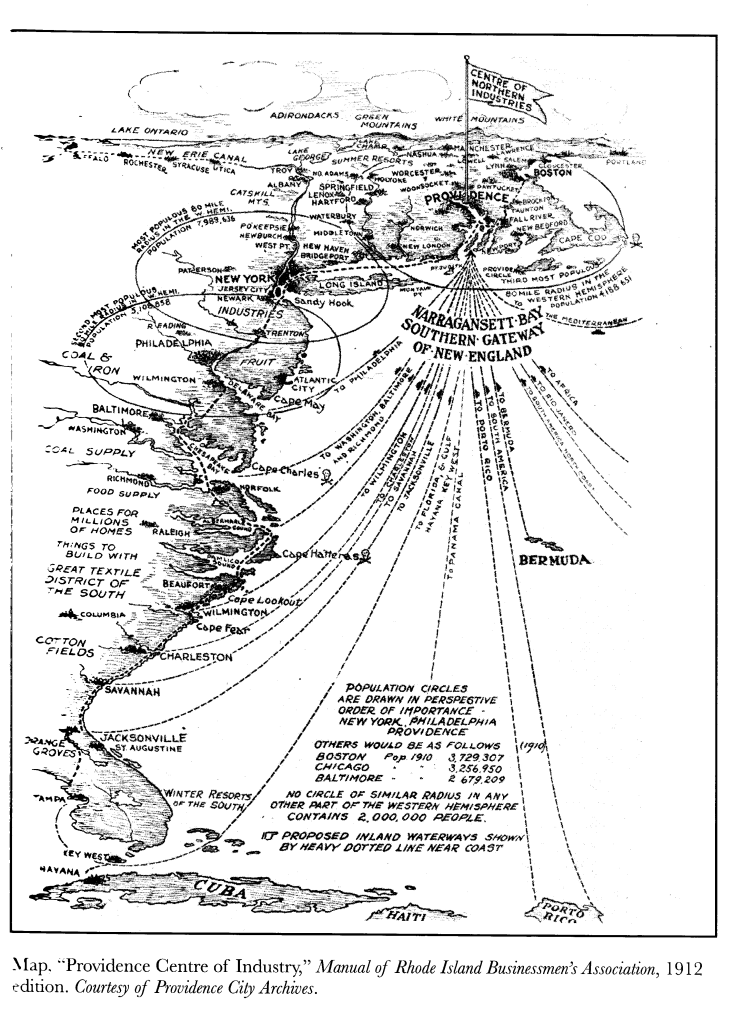
The book Lost Providence by David Brussat tells the story of the renewal of Providence and its architectural change. The author writes “Providence has one of the nation’s most intact historic downtowns and is one of America’s most beautiful cities.”
Page 25 in the Prologue shows an historic map showing Providence as the center of Northern Industries, a rival to Boston, New York and Philadelphia (see credits in the image below).
You can read this book and many other books about Providence at the Cole Farmhouse #USA1731
WASHINGTON LEVERETT COLE — The name of Cole has been identified with the history of Rhode Island since the early years of the struggle of the little colony for existence. The heraldic arms of the Cole family is as follows:
Arms – Quarterly, 1 and 4 argent, a bull passant gules, armed or, within a bordure sable bezantee, 2 and 3 gules, a lion rampant argent.
Crests – 1st – A demi-dragon holding an arrow or, headed and feathered argent.
2nd – A demi-lion rampant argent, gorged and chained or.
Motto – Deum cole, regem serva. (Worship God, protect the king).

The symbolic arms of the Cole family is as follows:
The shield is divided into four parts, the 1st and 4th being the armorial bearing of the husband and the 2nd and 3rd that of the wife. 1st quarter, the background is silver – silver in heraldry signifies wisdom, joy, peace and sincerity. The black border (called bordure) was formerly a mark of difference, to distinguish one branch of a family from the other. Its bezants (roundlets of gold), so called from the ancient gold coin of Byzantium, now Constantinople, denote that the ancestor had been to the Holy Land, very likely at the time of the Crusades (1200). The bull denotes strength and usefulness. Red (the color of the bull) in heraldry denotes fortitude, fire, victorious strength, triumph and power. The dragon (the crest on the left) is deemed the emblem of viciousness and envy. In armory it is properly applied to tyranny or the otherthrow of a vicious enemy. The arrow denotes the knighthood received for bravery in battle or otherwise, also swiftness and activity. The second quarter is showing a silver lion rampant (aggressive) in a red field. Red denotes fire – ‘a burning desire to spill one’s blood for God or country’. The lion is the symbol of strength, courage and generosity. The chain attached to its neck means that the life of the bearer of these arms was a continuous chain of brave and meritorious deeds.
The motto: Deum cole, regem serva, means translated: ‘Worship God, protect the king’, and was no doubt selected, outside of its appropriate and reverent meaning, as an allusion to the name.
The family which was founded in Rhode Island by James Cole, is a branch of the English Coles, one of the most ancient and honorable of early English houses. The Coles owned land in Essex, Wiltshire, Devonshire and Derbyshire under Edward the Confessor. In 1616, James Cole, progenitor of the Rhode Island Coles, lived at Highgate, London; he was a lover of flowers, and a great horticulturist, and married the daughter of de Lobel, the celebrated botanist and physician of James I., from whom the plant Lobelia is named. The Cole family owned lands on the ridge of hills called Highgate, near the Kingston line. James Cole subsequently came to America, settling in Rhode Island, where he founded the family of which the late Washington Leverett Cole was a member.
In 1667 the town of Swansea, Mass., was incorporated, including an expansive territory out of which later came several towns, among them Warren, R. I. In 1669, Hugh Cole, with others, purchased from King Philip, the Indian sachem, five hundred acres of land in Swansea, on the west side of Cole’s river (named for Hugh Cole, son of James Cole). At the outbreak of the Indian war two of Hugh Cole’s children were made prisoners by the Indians and were taken to Philip’s headquarters at Mount Hope. Philip, through a long standing friendship for their father, sent them back with the message that he did not wish to injure them, but in the event of an uprising might not be able to restrain his young braves. Philip advised that they repair to Rhode Island for safety. Hugh Cole removed immediately with his family, and had proceeded but a short distance when he beheld his house in flames. After the war he returned and located on the east side of Touisett Neck, on Kickmuet river, in Warren. The farm and well he made in 1677 are yet in possession of his lineal descendants. The friendship of the Indian warrior Philip for Hugh Cole is one of the few romantic and touching stories which come down to us from the whole revolting history of King Philip’s War.
Washington Leverett Cole was born in Providence, R. I., August 10, 1841, a descendant of the founder, James Cole, through his son, Hugh Cole, and son of Samuel Jackson and Frances (Sessions) Cole. He traced a maternal ancestry as distinguished as that of the Cole family. Samuel Jackson Cole was a man of means and position in Providence in the early part of the nineteenth century, a gentleman farmer, and the owner of a large estate, located in the section between Irving avenue and the Pawtucket line, and what is now the Blackstone Boulevard. He married Frances Sessions, member of a prominent old family of Providence.
Their son, Washington Leverett Cole, was educated in the private school of Samuel J. Austin, in Providence, and on completing his studies, became interested immediately in the management of his father’s large property and of his farm, eventually succeeding him in the control of the estate. He devoted his entire life to bringing this farm to a high standard of efficiency and excellence, purely for the love of the work, and for his deep interest in agriculture and dairying. The farm was famous for its herd of one hundred high grade cows, which was the pride of its owner. Mr. Cole conducted a large business in dairy products. He was widely known in Providence, and highly respected for the stern integrity and consistent justice of his life and of his business policies. Although he maintained a deep interest in public issues, he kept strictly aloof from political circles, and was independent of party restriction in casting his vote. He was in accord with the policies and principles of the Republican party on national issues, however. He was a member of the Episcopal church.
On December 28, 1872, Mr. Cole married Martha Stalker, who was born in Greenwich, R. I., daughter of Duncan and Lucy (Spencer) Stalker, her father a native of Glasgow, Scotland, and her mother of Warwick, R. I. Mrs. Cole survived her husband until November 15, 1916, when she passed away at the Cole home on Cole avenue, opposite Sessions street, in Providence. The Cole home has been preserved in as nearly as possible the form in which it was when early members of the Cole family entertained Washington and Lafayette, and contains among other relics of that day the chair in which the commander-in-chief sat. Mr. and Mrs. Cole were the parents of the following children: 1. Francis Sessions, manager of the Cole farm. 2. Jessie Leverett, who resides in the old homestead. 3. William Marchant, a contractor; married Ella Grahan Gulnac; issue: Janet, and William M., Jr. 4. Jackson Lanksford, ordained to the Episcopal priesthood in St. Paul’s Cathedral Church at Fond Du Lac, Wis., by the Rt. Rev. Reginald Heber Weller, D. D. and L.L. D., bishop, on June 2, 1918, and assumed charge of St. Andrew’s Mission at Kenosha, Wis. Washington Leverett Cole died at his home in Providence, March 17, 1911.
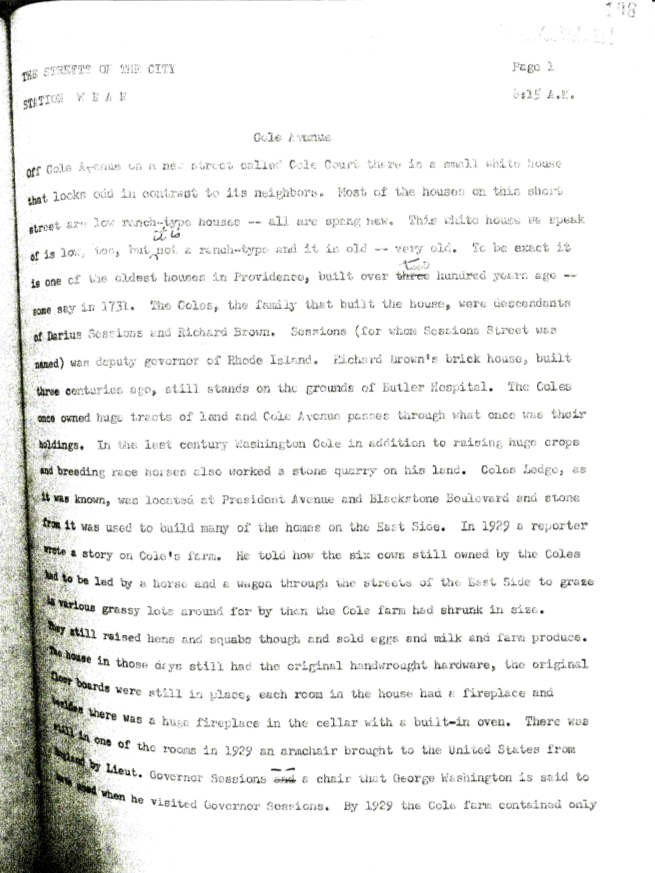
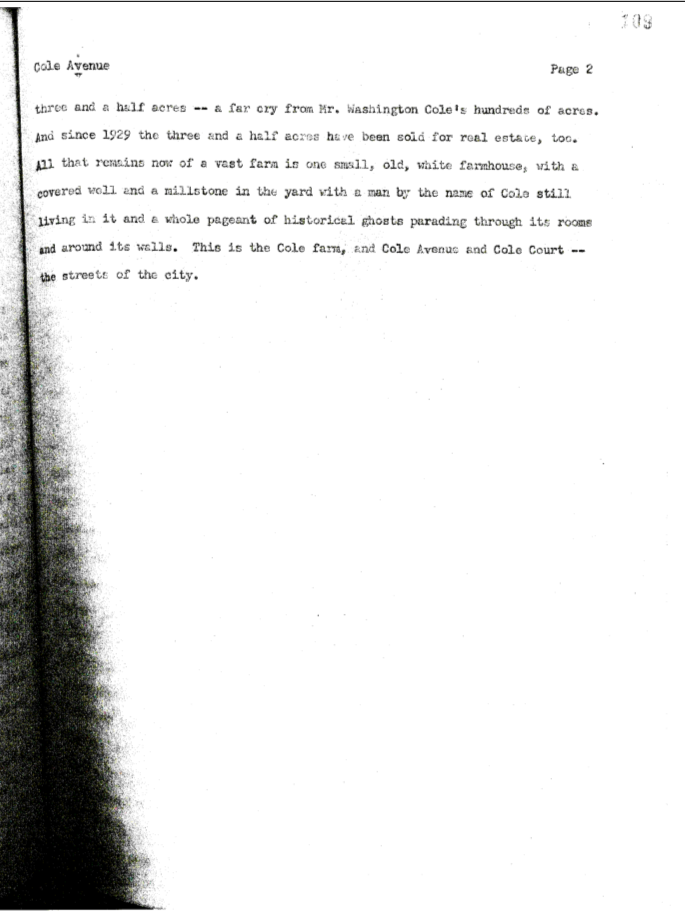
STREETS OF THE CITY (by Florence Parker Simister, transcripts of radio programs broadcast on WEAN 1954-1955)
STATION WEAN
Cole Avenue
Off Cole Avenue on a near street called Cole Court there is a small white house that looks odd in contrast to its neighbors. Most of the houses on this short street are low ranch-type houses — all are spang new. This white house we speak of is low, too, but it is not a ranch-type and it is old – very old. To be exact it is one of the oldest houses in Providence, built over two hundred years ago – some say in 1731. The Coles, the family that built the house, were descendants of Darius Sessions and Richard Brown. Sessions (for whom Sessions Street was named) was deputy governor of Rhode Island. Richard Brown’s brick house, built three centuries ago, still stands on the grounds of Butler Hospital. The Coles once owned huge tracts of land and Cole Avenue passes through what once was their holdings. In the last century Washington Cole in addition to raising huge crops and breeding racehorses also worked a stone quarry on his land. Coles Ledge, as it was known, was located at President Avenue and Blackstone Boulevard and stone from it was used to build many of the homes on the East Side. In 1929 a reporter wrote a story on Cole’s farm. He told how the six cows still owned by the Coles had to be led by a horse and a wagon through the streets of the East Side to graze is various grassy lots around for by then the Cole farm had shrunk in size. They still raised hens and squabs though and sold eggs and milk and farm produce. The house in those days still had the original handwrought hardware, the original floor boards were still in place, each room in the house had a fireplace and besides there was a huge fireplace in the cellar with a built-in oven. There was still in one of the rooms in 1929 an armchair brought to the United States from byland by Lieut. Governor Sessions — a chair that George Washington is said to have used when he visited Governor Sessions. By 1929 the Cole farm contained only three and a half acres — a far cry from Mr. Washington Cole’s hundreds of acres. And since 1929 the three and a half acres have been sold for real estate, too. All that remains now of a vast farm is one small, old, white farmhouse, with a covered well and a millstone in the yard with a man by the name of Cole still living in it and a whole pageant of historical ghosts parading through its rooms and around its walls. This is the Cole farm, and Cole Avenue and Cole Court –- the streets of the city.
As we celebrate Presidents Day tomorrow, we remember the historic visit of the Commander-in-chief to Providence, RI.
Here’s is a snippet from: http://sites.rootsweb.com/~rigenweb/articles/170.html “The Cole home has been preserved in as nearly as possible the form in which it was when early members of the Cole family entertained Washington and Lafayette, and contains among other relics of that day the chair in which the commander-in-chief sat.“
THE PROVIDENCE SUNDAY JOURNAL MAGAZINE, NOVEMBER 24, 1929
Cole Farm, in Centre of Residential Section, Takes Cattle to Pasture Past Exclusive Homes – House Built in 1731
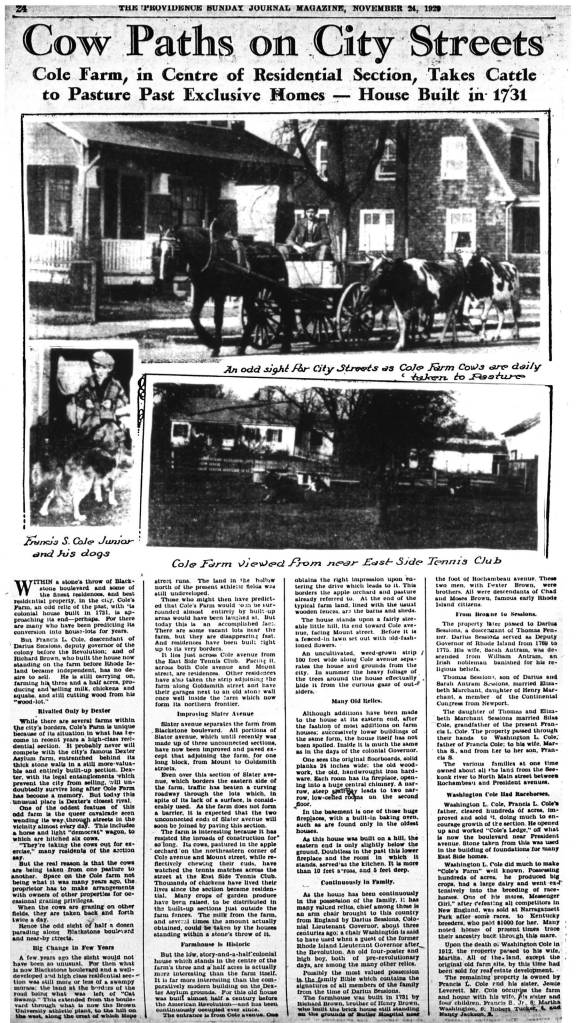
WITHIN a stone’s throw of Blackstone boulevard and some of the finest residences, and best residential property, in the city, Cole’s Farm, an odd relic of the past, with its colonial house built in 1731, is approaching its end – perhaps. For there are many who have been predicting its conversion into house-lots for years.
But Francis L. Cole, descendant of Darius Sessions, deputy governor of the colony before the Revolution; and of Richard Brown, who built the house now standing on the farm before Rhode Island became independent, has no desire to sell. He is still carrying on, farming his three and a half acres, producing and selling milk, chickens and squabs, and still cutting wood from his “wood-lot.”
Rivalled Only by Dexter
While there are several farms within the city’s borders, Cole’s Farm is unique because of its situation in what has become in recent years a high-class residential section. It probably never will complete with the city’s famous Dexter Asylum farm, entrenched behind its thick stone walls in a still more valuable and entirely built-up section. Dexter, with its legal entanglements which prevent the city from selling, will undoubtedly survive long after Cole Farm has become a memory. But today this unusual place is Dexter’s closest rival.
One of the oddest features of this odd farm is the queer cavalcade seen wending its way through streets in the vicinity almost every day. This includes a horse and light “democrat” wagon, to which are hitched six cows.
“They’re taking the cows out for exercise,” many residents of the section say.
But the real reason is that the cows are being taken from one pasture to another. Space on the Cole farm not being what it was many years ago, the proprietor has to make arrangements with owners of other properties for occasional grazing privileges.
When the cows are grazing on other fields, they are taken back and forth twice a day.
Hence the odd sight of half a dozen parading along Blackstone boulevard and near-by streets.
Big Change in Few Years
A few years ago the sight would not have been so unusual. For then what is now Blackstone boulevard and a well-developed and high class residential section was still more or less of a swampy morass; the land at the borders of the road being what was left of “Cat Swamp.” This extended from the boulevard through what is now the Brown University athletic plant, to the hill on the west, along the crest of which Hope street runs. The Land in the hollow north of the present athletic fields was still undeveloped.
Those who might then have predicted that Cole’s Farm would soon be surrounded almost entirely by built-up areas would have been laughed at. But today this is an accomplished fact. There are some vacant lots near the farm, but they are disappearing fast. And residences have been built sight up to its very borders.
It lies just across Cole avenue from the East Side Tennis Club. Facing it, across both Cole avenue and Mount street, are residences. Other residences have also taken the strip adjoining the farm along Goldsmith street and have their garages next to an old stone wall once well inside the farm which now form its northern frontier.
Improving Slater Avenue
Slater avenue separates the farm from Blackstone boulevard. All portions of Slater avenue, which until recently was made up of three unconnected sections, have now been improved and paved except that adjoining the farm, for one long block, from Mount to Goldsmith streets.
Even over this section of Slater avenue, which borders the eastern side of the farm, traffic has beaten a curving roadway through the lots which, in spite of its lack of a surface, is considerably used. As the farm does not form a barrier, it is expected that the two unconnected ends of Slater avenue will soon be joined by paving this section.
The farm is interesting because it has resisted the inroads of construction for so long. Its cows, pastured in the apple orchard on the northeastern corner of Cole avenue and Mount street, while reflectively chewing their cuds, have watched the tennis matches across the street at the East Side Tennis Club. Thousands of chickens have lived their lives since the section became residential. Many crops of garden produce have been raised, to be distributed in the built-up sections just outside in the farm fences. The milk from the farm, and several times the amount actually obtained, could be taken by the houses standing within a stone’s throw of it.
Farmhouse is Historic
But the low, story-and-a-half colonial house which stands in the centre of the farm’s three and a half acres is actually more interesting than the farm itself. It is far more interesting than the comparatively modern building on the Dexter Asylum grounds. For this old house was built almost half a century before the American Revolution – and has been continuously occupied ever since.
The entrance is from Cole avenue. One obtains the right impression upon entering the drive which leads to it. This borders the apple orchard and pasture already referred to. At the end of the typical farm land, lined with the usual wooden fences, are the barns and sheds.
The house stands upon a fairly sizeable little hill, its end toward Cole avenue, facing Mount street. Before it is a fenced-in lawn set out with old-fashioned flowers.
An uncultivated, weed-grown strip 100 feet wide along Cole avenue separates the house and grounds from the city. In summer the heavy foliage of the trees around the house effectually hide it from the curious gaze of outsiders.
Many Old Relics.
Although additions have been made to the house at its eastern end, after the fashion of most additions on farm houses; successively lower buildings of the same form, the house itself has not been spoiled. Inside it is much the same as in the days of the colonial Governor.
One sees the original floorboards, solid planks 24 inches wide; the old woodwork, the old, handwrought iron hardware. Each room has its fireplace, opening into a huge central chimney. A narrow, steep stairway leads to two narrow, low-celled rooms on the second floor.
In the basement is one of those huge fireplaces, with a built-in baking oven, such as are found only in the oldest houses.
As this house was built on a hill, the eastern end is only slightly below the ground. Doubtless in the past this lower fireplace and the room in which it stands, served as the kitchen. It is more than 10 feet across, and 5 feet deep.
Continuously in Family.
As the house has been continuously in the possession of the family. It has many valued relics, chief among these is an arm chair brought to this country from England by Darius Sessions. Colonial Lieutenant Governor, about three centuries ago; a chair Washington is said to have used when a guest of the former Rhode Island Lieutenant Governor after the Revolution. An old four-poster and high boy, both of pre-revolutionary days, are among the many other relics.
Possibly the most valued possession is the family Bible which contains the signatures of all members of the family from the time of Darius Sessions.
The farmhouse was built in 1731 by Richard Brown, brother of Henry Brown, who built the brick house still standing on the grounds of Butler Hospital near the foot of Rochambeau avenue. These two men, with Dexter Brown, were brothers. All were descendants of Chad and Moses Brown, famous early Rhode Island citizens.
From Browne to Sessions.
The property later passed to Darius Sessions, a descendant of Thomas Fenner. Darius Sessions served as Deputy Governor of Rhode Island from 1769 to 1775. His wife, Sarah Antram, was descended from William Antram, an Irish nobleman banished for his religious beliefs.
Thomas Sessions, son of Darius and Sarah Antram Sessions, married Elizabeth Marchant, daughter of Henry Marchant, a member of the Continental Congress from Newport.
The daughter of Thomas and Elizabeth Marchant Sessions married Silas Cole, grandfather of the present Francis L. Cole. The property passed through their hands to Washington L. Cole, father of Francis Cole; to his wife, Martha S., and from her to her son, Francis S.
The various families at one time owned about all the land from the Seekonk river to North Main street between Rochambeau and President avenues.
Washington Cole Had Racehorses.
Washington L. Cole, Francis L. Cole’s father, cleared hundreds of acres, improved and sold it, doing much to encourage growth of the section. He opened up and worked “Cole’s Ledge,” off what is now the boulevard near President avenue. Stone taken from this was used in the building of foundations for many East Side homes.
Washington L. Cole did much to make “Cole’s Farm” well known. Possessing hundreds of acres, he produced big crops, had a large dairy and went extensively into the breeding of racehorses. One of his mares, Messenger Girl,” after defeating all competitors in New England, was sold at Narragansett Park after some races, to Kentucky breeders, who paid $1000 for her. Many noted horses of present times trace their ancestry back through this mare.
Upon the death of Washington Cole in 1912, the property passed to his wife, Martha. All of the land, except the original old farm site, by this time had been sold for real estate development.
The remaining property is owned by Francis L. Cole and his sister, Jessie Leverett, Mr. Cole occupies the farm and house with his wife, his sister and four children. Francis S., Jr., 8; Martha Washington, 6; Robert Tucker, 4, and Nancy Jackson, 2.
 The historic Cole Farmhouse

You must be logged in to post a comment.